
From Policy to Purpose: A conversation with Deal Center ex-officio member, Dr. Garry McGiboney
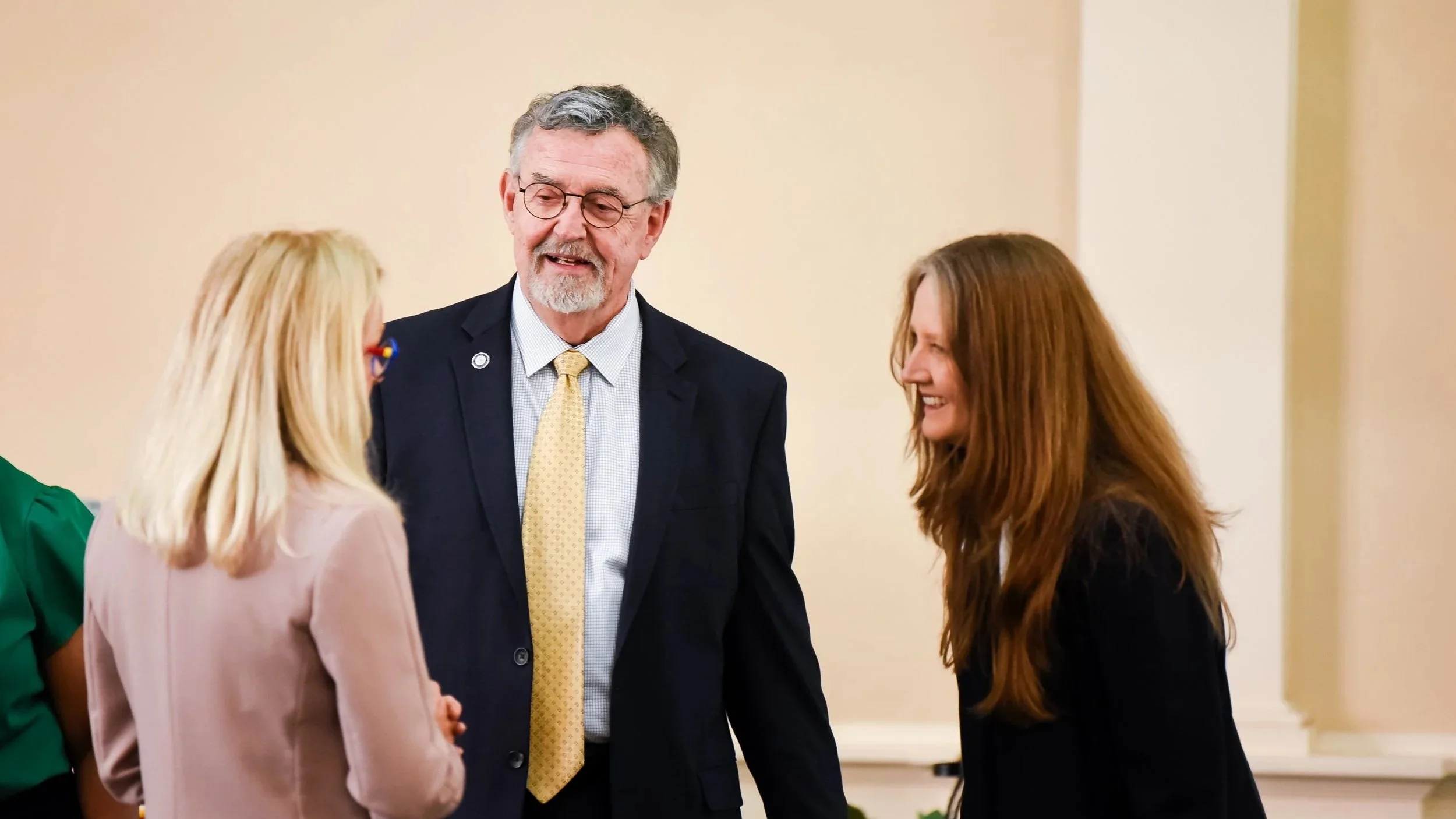
Dr. Garry McGiboney, Chief Operations Officer at Health Security Dynamics and Executive Director of Government Programs at Sharecare, has held many titles over his decorated career, but he was not always the erudite man we know today.
A high school dropout, McGiboney often found himself in trouble. He was sent to an adult work camp and assigned his own guard, which startled him to the realization that this could be his future.
After having gone to court several times, the judge gave him two options: go back to the work camp or go back to school. He says the choice wasn’t difficult.
"School sounded a lot better,” he said.
He left the experience with more than a hard lesson. An officer in court became McGiboney’s mentor. The officer visited him every week and became McGiboney’s “one caring adult.”
This experience taught McGiboney that he could be a mentor to children too.
McGiboney has three decades of experience speaking about child safety, school climate, mental health, school law, and policy development. His work has been influential throughout Georgia: his work influences the work done here at the Sandra Dunagan Deal Center, and how professional educators approach school climate, safety, and teaching.
“Sometimes all children need is to have somebody who will listen to them, and will support what they are trying to work through,” he said.
The same can be said for adults, something McGiboney has spent his career researching.
McGiboney is known for having novel work in safety initiatives and school climate. School climate is the crux of McGiboney’s focus. According to him, it is not just how children feel at school but also the mental health of educators in the school system, that affects students’ learning outcomes.
“If you're going to improve teacher retention and student attendance, you have to have a positive climate,” McGiboney said. “And frankly, if you want to improve academic outcomes, you have to have a positive school climate.”
If educators don't feel emotionally supported, how can they teach our children and stay in the school system? McGiboney’s research emphasizes that superintendents, principals, and teachers set the tone for either positive or negative energy in a school environment.
“Don’t be so focused on the outcome that you forget to develop a good process, because the process is the key to sustainability. Process over outcome, because with a good process, the desired outcomes will be there.” McGiboney said.
Here’s a tip from McGiboney: “We have to remain positive because things do work. We can make things better. We just have to have the will to make things better. And while it's okay to be task oriented, it can't be at the expense of being purpose driven.”
McGiboney, now ex-officio me co-authored and is referenced in the Language as a Missing Link Toolkit alongside other prominent literacy advocates. The toolkit is sponsored by the Deal Center and has become our most influential resource.
McGiboney contributed his work on school climate to the Language as a Missing Link Toolkit. One of Get Georgia Reading’s four pillars, a positive learning climate, is exactly what school climate is about.
"Human error is predictable, and if it’s predictable, it’s preventable,” he said. “There are ways you can create conditions, such as positive school climate, that will reduce the incidence likelihood of human error, which makes our schools safer and the climate more positive.”
Over the last three years he has dedicated himself to researching and writing a book on human error. The book, "Blind Spots: How Human Error Can Impact School Safety,” is made for professionals to implement in their schools to create a safer and more secure school environment, which he explains has become more pertinent over the last few years.
McGiboney has not strictly written for research. Last year he co-wrote and published a book alongside Kristina Viola, titled “Camila’s Changing Shells of Feelings.”
“It was very difficult. I really wanted to focus on three- to 10-year-olds because that’s when children first become keenly aware of their feelings and often struggle to understand them,” he said.
McGiboney is excited to continue aiding the Deal Center and Georgia with his research, advocating for school safety, climate, and human error.